
Dental Implant Procedure: What to Expect Before, During, and After Treatment
If you are considering replacing a missing tooth, understanding the dental implant procedure can make the decision feel less overwhelming. Implant treatment usually involves several carefully planned stages, beginning with a detailed examination and ending with a custom crown, bridge, or implant-supported denture.
Dental implants are designed to replace missing tooth roots and provide stable support for new teeth. Depending on your needs, they can replace one tooth, several teeth, or an entire arch.
This guide explains how dental implants work, each step of the treatment process, typical recovery expectations, possible benefits and risks, and how to care for your implant after treatment.
Schedule a dental implant consultation with Bluegrass Dentistry to receive a personalized evaluation from our Lexington implant team.
What Is a Dental Implant?
A dental implant is a small post placed in the jawbone to replace the root of a missing tooth. Most implants are made from biocompatible titanium, a material that can form a stable connection with the surrounding bone.
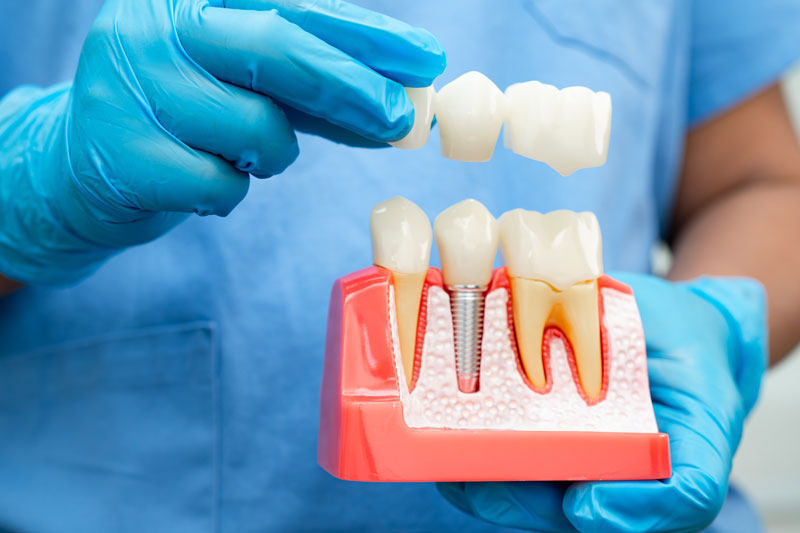
A complete single-tooth implant restoration generally has three main parts:
- Implant post: The portion surgically placed in the jawbone
- Abutment: The connector between the implant and the replacement tooth
- Crown: The visible, custom-made artificial tooth
Dental implants can also support bridges and dentures. This makes them a versatile treatment option for different degrees of tooth loss.
For a closer look at each component, visit our visual guide to the parts of a dental implant.
How Do Dental Implants Work?
A dental implant works by creating an artificial root inside the jawbone. After the implant is placed, bone gradually forms around its surface through a healing process called osseointegration.
Once the implant is stable, it can support a crown, bridge, or denture. Chewing pressure passes through the restoration and implant into the jawbone, similar to the way force travels through a natural tooth root.
This bone-level support is one of the primary differences between dental implants and conventional removable dentures. Dentures rest on the gums, while implants are anchored within the jaw.
What Can Dental Implants Replace?
Dental implants can be used in several different ways. Your recommended treatment will depend on how many teeth are missing, the condition of your remaining teeth, the available bone, and whether you prefer fixed or removable replacement teeth.
One Missing Tooth
A single implant and crown can replace one missing tooth without requiring the neighboring teeth to be reshaped for a traditional bridge.
Several Missing Teeth
Two or more implants may support a fixed bridge that replaces several adjacent teeth. An implant is not always required beneath every missing tooth.
An Unstable Denture
Implants can provide attachment points for a removable denture, helping reduce movement while eating and speaking.
All Teeth in One or Both Arches
Several strategically positioned implants can support a complete fixed bridge. Patients with extensive tooth loss can learn more about full-mouth dental implants in Lexington, KY.
The Dental Implant Procedure: Step by Step
Although every treatment plan is different, the dental implant process generally includes consultation, planning, implant placement, healing, and restoration.
Step 1: Consultation and Medical Review
Your first visit begins with a conversation about your concerns, health history, medications, previous dental treatment, and goals.
The dentist will evaluate:
- The location and number of missing teeth
- The health of your gums
- The condition of your remaining teeth
- Your bite and jaw movement
- Your jawbone volume and density
- Your medical conditions and medications
- Smoking or tobacco use
- Your expectations for treatment
Certain health conditions do not automatically prevent implant treatment, but they may affect healing or require additional precautions. Provide a complete and accurate medical history during your consultation.
Step 2: Three-Dimensional Imaging
A CBCT scan creates a detailed three-dimensional view of the teeth, jawbone, nerves, sinuses, and surrounding structures.
This imaging can help your implant dentist determine:
- Whether sufficient bone is available
- The appropriate implant size and position
- The location of important nerves and sinuses
- Whether bone grafting is needed
- Whether an existing infection is present
- The safest angle and depth for implant placement
Digital impressions, photographs, and intraoral scans may also be collected to plan the final restoration.
Step 3: Personalized Treatment Planning
The implant should be positioned with the final tooth in mind. This approach is sometimes called restoratively driven implant planning.
Your treatment plan should explain:
- The number of implants recommended
- The type of restoration
- Whether extractions are necessary
- Whether bone grafting is recommended
- Available sedation options
- Whether a temporary tooth can be provided
- The expected timeline
- The estimated treatment cost
For appropriate cases, digital planning may be used to create a custom surgical guide that helps transfer the planned implant position to the mouth.
Step 4: Preparatory Procedures
Some patients can proceed directly to implant surgery. Others need preliminary treatment to create a healthy and stable foundation.
Preparatory care may include:
- Removal of a damaged or infected tooth
- Treatment for gum disease
- Bone grafting
- Ridge augmentation
- Sinus augmentation
- Removal of an existing infection
In selected cases, an extraction, bone graft, and implant placement may be completed during the same appointment. Other situations require separate healing periods.
Step 5: Dental Implant Surgery
During dental implant surgery, the treatment area is numbed and the implant post is carefully positioned in the jawbone.
The general process includes:
- Numbing the treatment area
- Creating access to the jawbone
- Preparing the implant site
- Placing the implant
- Attaching a cover screw or healing component
- Closing or protecting the surgical site
The length of the appointment depends on the number of implants and whether extractions, grafting, or other procedures are performed at the same time.
Step 6: Temporary Tooth Replacement
A temporary tooth or restoration may be provided while the implant heals. Options can include a removable temporary appliance, a temporary bridge, or a provisional crown.
Some patients qualify for a temporary fixed tooth on the day of surgery. Immediate restoration depends on factors such as implant stability, bone quality, bite pressure, and the location of the implant.
Even when temporary teeth are attached immediately, the implant still needs time to integrate with the bone. Dietary and activity restrictions remain important during healing.
Step 7: Osseointegration and Healing
Osseointegration is the biological process through which the jawbone forms a stable connection with the implant surface.
This phase commonly takes several months, although healing time varies according to:
- The location of the implant
- Bone quality
- Implant stability
- Whether grafting was performed
- Your overall health
- Smoking or tobacco use
- Your adherence to post-operative instructions
Follow-up appointments allow the clinical team to monitor healing and evaluate the implant site.
Step 8: Abutment Placement
After the implant is stable, an abutment is attached. The abutment extends through the gum tissue and connects the implant to the final restoration.
Depending on the surgical approach, a healing abutment may already be visible above the gums. In other cases, a brief procedure is needed to uncover the implant.
Learn more about this component in our guide to dental implant abutments.
Step 9: Digital Scan or Impression
A digital scan or conventional impression records the implant position, neighboring teeth, gum contours, and bite. This information is used to design the final crown, bridge, or denture.
The restoration can be customized for:
- Tooth shape and size
- Color and translucency
- Gumline contours
- Bite alignment
- Contact with neighboring teeth
- Comfort and cleanability
Step 10: Final Restoration
The final crown, bridge, or denture is attached after the implant and surrounding tissues are ready.
Your dentist will evaluate its fit, appearance, bite, speech, and stability. The restoration may be secured with a screw or dental cement, depending on its design and position.
How Long Does the Dental Implant Process Take?
The complete dental implant process may take several months. However, there is no universal timeline because treatment depends on the condition of the tooth, available bone, healing response, and type of restoration.
A straightforward case may involve implant placement followed by several months of healing and final crown placement. A more complex case involving extraction, infection, or bone grafting may take longer.
In certain circumstances, multiple stages can be combined. For example, a damaged tooth may be removed and an implant placed during the same appointment. Some patients may also qualify for immediate temporary teeth.
Your dentist should provide a personalized timeline after completing the examination and reviewing your imaging.
Does the Dental Implant Procedure Hurt?
Local anesthesia is used to numb the implant site during surgery. Sedation may also be available for patients who feel anxious or are undergoing a longer procedure.
Patients may notice pressure or vibration during treatment, but the area should remain numb. After surgery, temporary effects can include:
- Soreness
- Swelling
- Bruising
- Minor bleeding
- Jaw stiffness
- Tenderness near the implant site
These effects commonly improve as healing progresses. Your implant team will provide instructions for medication, swelling control, diet, hygiene, and physical activity.
Read our detailed guide to pain and discomfort during dental implant treatment.
What Is Recovery Like After Implant Surgery?
Many patients return to light activities within a few days, although recovery varies. More extensive surgery, multiple extractions, bone grafting, or full-arch treatment may require additional time.
During early recovery, you may be instructed to:
- Use cold packs as directed
- Take prescribed or recommended medication
- Eat soft foods
- Avoid strenuous activity
- Avoid smoking and tobacco
- Keep the area clean without disturbing the surgical site
- Avoid hard chewing over the implant
- Attend scheduled follow-up visits
Contact the office if you experience severe or increasing pain, persistent bleeding, fever, worsening swelling, drainage, or movement of a temporary restoration.
For more detailed guidance, review what to expect after implant-post surgery.
What Can You Eat After Dental Implant Surgery?
A soft diet helps protect the surgical area and limits pressure on the healing implant.
Suitable foods may include:
- Eggs
- Yogurt
- Applesauce
- Mashed vegetables
- Smooth soups
- Soft pasta
- Cooked fish
- Protein shakes consumed without a straw
Avoid hard, crunchy, sticky, or chewy foods until your dentist confirms that normal chewing can safely resume.
Benefits of Dental Implants
Stable Tooth Replacement
Because the implant is positioned within the jawbone, it can provide stable support for a crown, bridge, or denture.
Natural Appearance
The visible restoration can be customized to complement your remaining teeth, smile, and facial proportions.
Improved Chewing Function
Implant-supported teeth can make it easier to bite and chew compared with an unstable removable appliance.
Jawbone Support
A missing tooth root no longer transfers chewing pressure into the jawbone. An implant restores stimulation around the implant site, helping maintain supporting bone.
Protection of Neighboring Teeth
A single implant generally does not require reshaping healthy adjacent teeth for support, as a traditional bridge may.
Versatility
Implants can replace one tooth, several teeth, or an entire arch. They may support fixed or removable restorations depending on the patient’s needs.
Potential Risks and Considerations
Dental implants have an established record of clinical use, but no surgical treatment is risk-free or guaranteed.
Possible complications include:
- Infection
- Delayed healing
- Failure of the implant to integrate
- Temporary or persistent nerve symptoms
- Sinus complications involving upper implants
- Gum recession
- Bone loss around the implant
- Loose or fractured restorative components
- Damage to the crown, bridge, or denture
Risk may be affected by smoking, uncontrolled diabetes, poor oral hygiene, untreated gum disease, teeth grinding, certain medications, and failure to attend maintenance visits.
A careful evaluation allows your dentist to discuss individual risks, treatment alternatives, and reasonable expectations before surgery.
What If You Do Not Have Enough Jawbone?
Some patients lose bone after an extraction, infection, gum disease, trauma, or years of wearing dentures. Insufficient bone does not automatically mean implants are impossible.
Depending on the location and extent of bone loss, treatment options may include:
- Bone grafting
- Ridge augmentation
- Sinus augmentation
- Shorter or narrower implants
- Angled implant placement
- Alternative full-arch implant techniques
Bluegrass Dentistry also evaluates advanced implant options for patients with severe upper-jaw bone loss. Learn more about zygomatic dental implants.
How to Care for a Dental Implant
An implant cannot develop a cavity, but the surrounding gums and bone still require consistent care. Plaque accumulation can cause inflammation and damage the tissues supporting the implant.
To care for your implant:
- Brush at least twice daily
- Clean carefully along the implant gumline
- Floss or use an interdental brush as directed
- Use a water flosser when recommended
- Attend regular examinations and professional cleanings
- Avoid smoking and tobacco
- Wear a nightguard if you grind or clench your teeth
- Report looseness, bleeding, swelling, or bite changes promptly
Implant-supported bridges and full-arch restorations require special cleaning beneath the prosthesis. Your dental team should demonstrate the appropriate tools and techniques.
How Long Do Dental Implants Last?
Dental implants are intended to provide long-term support, but their lifespan varies. Oral hygiene, gum health, smoking, medical conditions, bite forces, teeth grinding, and professional maintenance can all affect longevity.
The implant post and visible restoration should be considered separately. The implant may remain stable while the crown, screw, abutment, denture attachment, or bridge eventually needs adjustment, repair, or replacement.
Learn more in our guide to how long dental implants can last.
How Much Does a Dental Implant Procedure Cost?
The cost of dental implant treatment depends on the scope and complexity of the case.
Factors affecting the total investment may include:
- The number of implants
- The type of final restoration
- Tooth extractions
- Bone grafting
- Sedation or anesthesia
- Temporary teeth
- Restorative materials
- Laboratory or in-house fabrication
- Follow-up care
Request a written treatment plan explaining what the fee includes. When comparing estimates, determine whether imaging, sedation, extractions, grafting, temporary teeth, the final restoration, and follow-up care are included.
Dental insurance may contribute toward certain parts of treatment, but coverage varies. Financing options may also help qualified patients divide treatment expenses into monthly payments.
Why Choose Bluegrass Dentistry for Dental Implants in Lexington, KY?
Bluegrass Dentistry provides implant planning, surgery, restoration, and follow-up care in one Lexington location. Keeping these phases within a coordinated team can improve communication between the surgical and restorative portions of treatment.
The practice uses a digital workflow that may include:
- Three-dimensional CBCT imaging
- Digital smile planning
- Computer-guided implant surgery
- Custom surgical guides
- In-house 3D printing and milling
- Temporary and final restorations
- Fixed and removable implant solutions
- Advanced options for significant bone loss
Dr. Seth Chambers has focused extensively on implant surgery, restorative dentistry, digital treatment planning, and full-mouth rehabilitation. Each treatment plan is developed around the patient’s anatomy, health, functional needs, and desired outcome.
Patients who experience dental anxiety can also discuss available sedation dentistry options.
Schedule a Dental Implant Consultation in Lexington, KY
If a missing or failing tooth is affecting your comfort, diet, appearance, or confidence, a dental implant consultation can help you understand your options.
During your visit, the Bluegrass Dentistry team can evaluate your oral health, review three-dimensional imaging, explain the anticipated dental implant process, and provide a personalized treatment plan.
Contact Bluegrass Dentistry to schedule your dental implant consultation or call our new-patient team at (859) 251-2866.