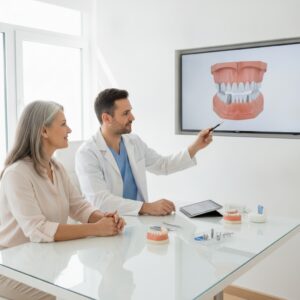

All-on-4 Dental Implants in Lexington, KY: A Complete Patient Guide
If you are living with extensive tooth loss, failing teeth, or an unstable denture, All-on-4 dental implants may offer a fixed and more functional way to restore your smile.
This full-arch treatment uses a carefully planned group of dental implants to support an entire row of replacement teeth. For qualifying patients, a temporary fixed restoration may be attached on the day of implant surgery, allowing them to leave the office with a complete smile.
In this guide, you will learn how All-on-4 dental implants work, who may qualify, what happens during treatment, how recovery is managed, what affects cost, and how to choose an implant provider in Lexington, Kentucky.
Schedule your dental implant consultation with Bluegrass Dentistry to receive recommendations based on your health, anatomy, and treatment goals.
What Are All-on-4 Dental Implants?
All-on-4 is a full-arch dental implant treatment designed to replace all the teeth in the upper jaw, lower jaw, or both. Instead of using one implant for every missing tooth, the treatment uses a smaller number of strategically positioned implants to support a complete fixed bridge.
Despite the name, full-arch treatment does not always involve exactly four implants. Depending on your bone structure, bite, health, and restorative needs, your dentist may recommend four, five, six, or more implants. For this reason, treatment may also be described as All-on-X or full-arch dental implants.
The implants act as artificial tooth roots. A custom bridge is secured to them to create a stable row of replacement teeth that does not rest loosely on the gums like a conventional removable denture.
Patients researching comprehensive tooth replacement can learn more about full-mouth dental implants in Lexington, KY.
How Is All-on-4 Different From Traditional Dentures?
Traditional dentures are removable appliances supported primarily by the gums. Although dentures can replace missing teeth and improve appearance, they may shift while eating or speaking. Changes in the jawbone can also affect their fit over time.
An All-on-4 restoration is secured to dental implants placed in the jawbone. This creates a more stable foundation for chewing, speaking, and smiling.
Potential differences include:
- Stability: Implant-supported teeth remain fixed rather than relying on adhesive or suction.
- Chewing function: A fixed restoration can make it easier to eat a wider variety of foods.
- Comfort: Implant-supported teeth do not move against the gums like a loose denture can.
- Appearance: The bridge is customized around your facial features, lip support, smile line, and aesthetic goals.
- Bone stimulation: Dental implants transfer biting forces into the jawbone, helping maintain bone around the implant sites.
- Daily use: Fixed teeth stay in place and are cleaned inside the mouth instead of being removed each night.
Every option has advantages and limitations. Some patients may prefer a removable implant-supported restoration, while others are better served by fixed full-arch teeth. Your dentist should explain the differences before recommending treatment.
Who May Be a Candidate for All-on-4 Dental Implants?
All-on-4 dental implants are generally intended for adults who need to replace most or all the teeth in an arch.
You may be a candidate if:
- You are missing all or most of your upper or lower teeth.
- Your remaining teeth are severely decayed, loose, fractured, or otherwise unable to be predictably restored.
- You are frustrated with a loose or uncomfortable removable denture.
- You want a fixed alternative to traditional dentures.
- You want to improve your ability to bite, chew, speak, and smile.
- Your overall health is stable enough for oral surgery.
- You are willing to follow post-surgical instructions and attend maintenance appointments.
Conditions such as diabetes, gum disease, teeth grinding, or reduced bone volume do not automatically disqualify every patient. However, they may affect treatment planning, healing, implant positioning, or long-term maintenance.
A comprehensive examination and three-dimensional imaging are necessary to determine whether All-on-4, another full-arch implant option, or a different type of tooth replacement is appropriate.
Can You Get All-on-4 Implants With Bone Loss?
Many patients seeking full-mouth dental implants have experienced some degree of jawbone loss. This may occur after years of missing teeth, advanced gum disease, infection, or long-term denture use.
Bone loss does not necessarily mean you cannot receive dental implants. Angled implant placement, longer implants, bone grafting, or other advanced techniques may allow treatment to proceed.
For patients with severe upper-jaw bone loss, specialized solutions such as zygomatic implants may sometimes be considered. Zygomatic implants require advanced surgical training and are anchored in denser facial bone rather than relying entirely on the upper jawbone.
The appropriate approach can only be determined after your implant team evaluates your CBCT scan, medical history, bone structure, sinuses, nerves, bite, and restorative needs.
The All-on-4 Dental Implant Process
Full-arch implant treatment involves more than placing implant posts. The final teeth, bite, facial support, implant positions, and long-term maintenance requirements should all be considered before surgery begins.
1. Comprehensive Implant Consultation
Your first appointment typically includes a discussion of your concerns, goals, health history, medications, and previous dental experiences.
The clinical evaluation may include:
- A comprehensive dental examination
- A three-dimensional CBCT scan
- Digital photographs
- Digital impressions or intraoral scans
- An evaluation of your teeth and gums
- A review of your bite and jaw movement
- An assessment of your facial structure and smile line
This information helps the implant team identify infection, measure available bone, locate anatomical structures, and determine where the implants can be placed safely.
2. Digital Smile and Surgical Planning
A modern full-arch workflow begins by planning the desired appearance and function of the final teeth. The surgical plan can then be developed around that restorative outcome.
Digital planning may be used to determine:
- The number of implants needed
- The position, angle, and depth of each implant
- The size and shape of the replacement teeth
- The appropriate amount of facial and lip support
- Whether bone reduction or grafting is necessary
- Whether immediate temporary teeth are feasible
A custom surgical guide may also be created to help transfer the digital plan accurately to the mouth during surgery.
3. Extractions and Implant Placement
If failing teeth remain, they may be removed during the implant surgery appointment. The implant sites are then prepared, and the implants are positioned according to the treatment plan.
Bluegrass Dentistry offers comprehensive dental implant surgery in Lexington, including digital planning and guided placement for appropriate cases.
4. Placement of Temporary Fixed Teeth
Many patients can receive a temporary fixed bridge on the day their implants are placed. This is sometimes called immediate loading, same-day teeth, or Teeth-in-a-Day.
Immediate temporary teeth are not guaranteed in every case. The implants must achieve sufficient stability, and the patient must meet specific clinical requirements. If the implants cannot be safely loaded immediately, an alternative temporary restoration may be recommended while healing occurs.
The temporary bridge is designed to protect the surgical sites, restore appearance, and provide limited function during healing. Patients must follow a modified diet to avoid placing excessive force on the implants before they have integrated with the bone.
5. Healing and Osseointegration
During the next several months, the implants bond with the surrounding jawbone through a process called osseointegration.
Follow-up visits allow the clinical team to:
- Monitor healing
- Evaluate the gums and implant sites
- Adjust the temporary teeth
- Review cleaning techniques
- Check the bite
- Confirm that dietary guidelines are being followed
Although the temporary bridge may feel secure, the implants are still healing beneath the gums. Following activity, hygiene, and dietary instructions is an important part of protecting the treatment.
6. Delivery of the Final Full-Arch Restoration
After healing is complete, new records may be taken to design the final bridge. Your dentist will evaluate the fit, tooth shape, color, bite, speech, and overall appearance before the final restoration is completed.
Full-arch restorations may be fabricated from zirconia, high-strength acrylic, or a combination of materials. Your provider should explain why a particular material is being recommended and how it may affect appearance, durability, maintenance, and repair.
What Sedation Options Are Available?
Full-arch implant surgery can often be completed with dental sedation. The recommended option depends on your health, anxiety level, procedure length, and case complexity.
Available options may include:
- Nitrous oxide
- Oral conscious sedation
- Intravenous sedation
- General anesthesia for appropriate cases
Your provider should review your medical history carefully and explain what you may experience before, during, and after sedation.
Patients concerned about dental anxiety can explore sedation dentistry options at Bluegrass Dentistry.
All-on-4 Recovery: What Should You Expect?
Recovery varies according to the extent of surgery, the number of extractions, the implant locations, your general health, and how closely you follow post-operative instructions.
Common short-term effects can include:
- Swelling
- Bruising
- Tenderness
- Minor bleeding or oozing
- Jaw stiffness
- Temporary changes in speech
- Fatigue after surgery or sedation
Swelling frequently becomes most noticeable during the first few days and then gradually improves. Many patients can return to light, non-strenuous activities within several days, but individual recovery times differ.
You will receive instructions covering medication, oral hygiene, physical activity, swelling control, and foods to avoid. Contact the office promptly if you experience severe or worsening pain, persistent bleeding, fever, difficulty breathing, or any other symptoms identified by your surgical team.
What Can You Eat After All-on-4 Surgery?
Your temporary teeth are not intended for unrestricted chewing while the implants heal. A soft or modified diet reduces pressure on the implants during osseointegration.
Recommended foods may include:
- Eggs
- Yogurt
- Smooth soups
- Mashed vegetables
- Soft pasta
- Cooked fish
- Protein shakes consumed without a straw
- Other foods that can be easily cut with a fork
Avoid hard, crunchy, sticky, or chewy foods until your implant team confirms that normal chewing can safely resume.
Potential Risks and Complications
All-on-4 treatment has surgical and restorative risks. Understanding these considerations helps you make an informed decision and recognize the importance of proper planning and follow-up care.
Potential complications may include:
- Infection
- Delayed healing
- Failure of an implant to integrate
- Temporary or persistent nerve symptoms
- Sinus-related complications in the upper jaw
- Damage to the temporary or final bridge
- Loose prosthetic screws
- Inflammation or bone loss around an implant
- Bite or speech concerns requiring adjustment
Risk can be influenced by tobacco use, uncontrolled diabetes, poor hygiene, untreated gum disease, teeth grinding, inadequate follow-up care, or excessive force on the implants during healing.
Careful diagnostics, guided planning, an experienced surgical and restorative team, and consistent maintenance can help reduce—but cannot eliminate—these risks.
How Long Do All-on-4 Dental Implants Last?
The implants and the bridge should be considered separate parts of the restoration. Implant posts are designed for long-term use, whereas prosthetic teeth, screws, and other restorative components may wear over time and require maintenance, repair, or replacement.
Longevity depends on factors such as:
- Oral hygiene
- Smoking or tobacco use
- Gum and bone health
- Teeth grinding or clenching
- The design and material of the restoration
- Bite forces
- Medical conditions
- Professional maintenance
Your provider should explain what is included in the treatment, what maintenance may be needed, and whether the restoration comes with a written warranty.
How Do You Clean All-on-4 Dental Implants?
Fixed implant teeth cannot develop cavities, but plaque and bacteria can still collect around the implants and beneath the bridge. Without proper care, inflammation may damage the gums and bone that support the implants.
Your daily routine may include:
- Brushing at least twice a day
- Cleaning beneath the bridge with implant floss
- Using interdental brushes
- Using a water flosser when recommended
- Cleaning along the gumline carefully
- Wearing a nightguard if you grind your teeth
Professional implant maintenance is typically recommended at regular intervals. The frequency will depend on your health, hygiene, risk factors, and the design of your restoration.
How Much Do All-on-4 Dental Implants Cost in Lexington, KY?
There is no single price that applies to every full-arch implant case. The investment depends on the extent and complexity of treatment.
Cost factors may include:
- Whether one or both arches are treated
- The number and type of implants
- Necessary tooth extractions
- Bone grafting or advanced surgical procedures
- The form of sedation or anesthesia
- The temporary restoration
- The material used for the final bridge
- Laboratory and digital-design services
- Follow-up appointments
- Maintenance plans or warranties
When comparing implant estimates, request an itemized or all-inclusive treatment plan. A low advertised price may not include imaging, sedation, extractions, temporary teeth, the final restoration, or follow-up care.
Learn more about evaluating value and long-term expenses in our guide to the cost and long-term value of full-mouth dental implants.
Does Insurance Cover All-on-4 Dental Implants?
Dental insurance benefits vary considerably. A plan may contribute toward examinations, imaging, extractions, or be part of the prosthetic treatment while limiting or excluding coverage for implant placement.
Medical insurance may occasionally provide benefits when treatment is related to qualifying trauma or medical circumstances, but coverage should not be assumed.
Ask your provider for procedure codes and a written estimate so you can verify benefits directly with your insurance carrier. Financing may also be available to divide the cost into monthly payments for qualified applicants.
How to Choose an All-on-4 Implant Provider
Full-arch implant treatment combines oral surgery, restorative dentistry, digital planning, prosthetic design, and long-term maintenance. The experience and workflow of the treatment team can affect every stage of care.
Before selecting a provider, ask:
- How frequently do you perform full-arch implant treatment?
- What advanced implant training have you completed?
- Who will perform the surgery?
- Who will design and deliver the final teeth?
- Do you use CBCT imaging and guided surgery?
- Are temporary teeth available on the day of surgery?
- How do you manage patients with significant bone loss?
- Which materials do you use for the final restoration?
- Can I see before-and-after examples of similar cases?
- What happens if an implant does not integrate?
- What follow-up care and maintenance are included?
- Is there a written warranty?
Be cautious of choosing treatment based only on the lowest advertised price. Ask what is included, who performs each phase of care, and whether the practice can manage complications or advanced surgical needs.
Why Patients Choose Bluegrass Dentistry
Bluegrass Dentistry provides surgical and restorative dental implant care at a single Lexington location. Dr. Seth Chambers and the implant team use three-dimensional imaging, digital smile planning, guided surgery, and in-house prosthetic technology to coordinate treatment from the initial evaluation through the final restoration.
Dr. Chambers has focused extensively on implant dentistry and full-arch treatment. You can learn more about his experience and training on the Dr. Seth Chambers biography page.
Bluegrass Dentistry also evaluates patients with complex dental conditions and significant bone loss. The objective is to develop a treatment plan based on each patient’s anatomy, health, functional needs, and desired outcome—not to apply the same treatment protocol to every patient.
Schedule an All-on-4 Dental Implant Consultation in Lexington, KY
If failing teeth or loose dentures are affecting your comfort, diet, or confidence, a full-arch implant consultation can help you understand your available options.
At Bluegrass Dentistry, your evaluation includes a detailed review of your oral health, anatomy, treatment goals, and possible financial options. The team can explain whether All-on-4, All-on-6, another full-mouth implant approach, or an alternative treatment is best suited to your situation.
Contact Bluegrass Dentistry to schedule your dental implant consultation or call the new-patient team at (859) 251-2866.
Bluegrass Dentistry
3475 Richmond Road, Suite 150
Lexington, KY 40509