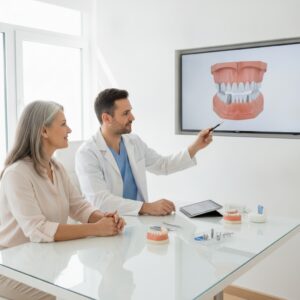

Dental Implants in Lexington, KY
Missing teeth can affect much more than the appearance of your smile. They may make it difficult to enjoy certain foods, speak clearly, or feel confident in everyday situations. At Bluegrass Dentistry, we provide personalized dental implant treatment in Lexington, KY, to help patients rebuild comfortable, functional, and natural-looking smiles.
Dental implants replace missing tooth roots with durable posts that support a custom crown, bridge, or full-arch restoration. Because they are secured within the jawbone, implants can provide greater stability than removable tooth-replacement options while helping preserve the structure of your smile.
Schedule a dental implant consultation to learn which treatment options may be appropriate for you.
What Is a Dental Implant?
A dental implant is a small post placed in the jawbone to replace the root of a missing tooth. Most implant posts are made from biocompatible titanium and are designed to integrate with the surrounding bone through a natural healing process called osseointegration.
Once the implant is stable, it can support one of several types of restorations:
- A dental crown for one missing tooth
- An implant-supported bridge for several missing teeth
- An implant-supported denture
- A fixed full-arch restoration for an entire row of teeth
Each restoration is planned to complement your facial features, bite, and remaining natural teeth. Patients who need to replace most or all of their teeth can also explore our full-mouth dental implant options.
Benefits of Dental Implants
Dental implants are designed to restore both the visible portion of a missing tooth and the support normally provided by its root. This creates several potential functional and cosmetic benefits.
Improved Stability
Because implants are anchored in the jawbone, they do not rely solely on the gums or neighboring teeth for support. A properly planned implant restoration can remain stable while you eat, speak, and smile.
A Natural-Looking Smile
The crown, bridge, or full-arch restoration attached to an implant can be customized to create a balanced, lifelike appearance. The goal is to restore your smile without drawing attention to the dental work itself.
Jawbone Preservation
After a tooth is lost, the bone that once supported its root may gradually decrease in volume. An implant transfers stimulation to the jawbone during normal biting and chewing, helping maintain bone in the treated area.
Protection for Nearby Teeth
A traditional dental bridge may require neighboring teeth to be reshaped for support. A single dental implant can replace a missing tooth without relying on adjacent healthy teeth.
Comfort When Eating and Speaking
Stable implant restorations can make it easier to chew a wider range of foods and speak without worrying about a removable appliance shifting out of position.
Long-Term Tooth Replacement
Dental implants are designed to provide lasting support when they are combined with good oral hygiene, regular professional care, and appropriate maintenance.
Who May Be a Candidate for Dental Implants?
You may be a candidate for implant dentistry if you have one or more missing teeth, badly damaged teeth, recurring dental infections, or an uncomfortable removable denture.
During your evaluation, our team will review factors such as:
- Your dental and medical history
- The condition of your teeth and gums
- Your jawbone volume and density
- Your bite and facial structure
- Your medications and overall health
- Your treatment goals and preferred timeline
Insufficient bone does not automatically prevent someone from receiving implants. Bone grafting or advanced implant techniques may make treatment possible for patients with bone loss. The only way to determine candidacy is through a clinical examination and detailed imaging.
Patients who are unsure where to begin can review our guide to the new-patient consultation process.
The Dental Implant Process
Every dental implant case is different, but treatment generally includes the following stages.
1. Consultation and Digital Evaluation
Your treatment begins with a comprehensive examination and a conversation about your concerns, priorities, and desired outcome. Digital imaging allows our team to evaluate your jawbone, tooth position, nerves, sinuses, and other important anatomical structures.
2. Personalized Treatment Planning
Dr. Seth Chambers develops a treatment plan based on the number of teeth being replaced, the available bone, the type of restoration needed, and your overall oral health. Your plan will also address whether extractions, bone grafting, sedation, or other procedures are recommended.
3. Implant Placement
During dental implant surgery, the implant post is carefully positioned within the jawbone. Depending on your treatment plan and implant stability, a temporary tooth or provisional restoration may be placed during the same phase of care.
4. Healing and Osseointegration
The implant needs time to bond with the surrounding jawbone. Healing time varies based on the implant location, bone quality, overall health, and whether additional procedures were performed.
5. Final Restoration
After the implant has integrated successfully, a custom crown, bridge, or full-arch restoration is attached. The final restoration is adjusted for comfort, bite alignment, appearance, and function.
Dental Implants for One Missing Tooth
A single dental implant can replace an individual missing tooth without requiring support from neighboring teeth. The implant serves as the new root, while a custom crown restores the visible portion of the tooth.
This option may be recommended when a tooth has already been lost or cannot be predictably restored due to severe decay, fracture, infection, or another condition.
Implant-Supported Bridges for Multiple Missing Teeth
Several missing teeth do not always require an implant for every individual tooth. In some cases, two or more implants can support a fixed bridge that replaces multiple teeth in the same area.
An implant-supported bridge can restore chewing function while avoiding a removable partial denture. The number and position of the implants will depend on your bite, bone support, and the number of teeth being replaced.
Full-Mouth Dental Implants
Patients with extensive tooth loss, failing teeth, or uncomfortable dentures may benefit from a fixed full-arch restoration. This treatment uses strategically positioned implants to support a complete row of replacement teeth.
Full-mouth treatment can provide a more stable alternative to traditional removable dentures. At Bluegrass Dentistry, the process may include digital planning, implant placement, temporary teeth, and fabrication of your final restoration.
Learn more about full-mouth dental implants in Lexington, including potential treatment options for patients with significant bone loss.
What If I Have Bone Loss?
Jawbone volume is an important consideration in implant treatment, but bone loss does not necessarily mean you are ineligible. Depending on your anatomy and treatment goals, your plan may include bone grafting or an advanced implant approach.
Digital imaging helps our team understand how much bone is available and select an appropriate treatment strategy. Some patients can receive a graft and implant during the same appointment, while others benefit from allowing the grafted area to heal first.
Dental Implant Technology at Bluegrass Dentistry
Detailed planning is essential to implant dentistry. Bluegrass Dentistry uses a digital workflow to evaluate anatomy, plan implant positioning, and design customized restorations.
Our implant technology may include:
- Three-dimensional CBCT imaging
- Digital treatment planning
- Computer-guided implant placement
- Digital smile design
- On-site 3D printing and milling
- Custom temporary and final restorations
Keeping surgical and restorative phases within one practice can improve communication and create a more coordinated experience from consultation through follow-up care.
Why Choose Dr. Seth Chambers?
Dr. Seth Chambers has pursued advanced education in implant placement, restoration, full-mouth rehabilitation, and digital dentistry. His approach combines careful surgical planning with attention to the appearance, comfort, and function of the final teeth.
Bluegrass Dentistry focuses on providing comprehensive implant care under one roof. This means patients can receive imaging, surgical treatment, restorative care, and ongoing follow-up from a coordinated Lexington dental implant team.
Every treatment plan is customized. Dr. Chambers considers your oral health, anatomy, lifestyle, goals, and concerns before recommending a procedure.
Are Dental Implants Painful?
Your comfort is an important part of treatment. Local anesthesia is used during implant placement, and sedation options may be available based on your procedure and individual needs.
Some tenderness, swelling, or minor bleeding can occur after surgery. These symptoms are often manageable with the instructions and medications provided by the clinical team. Many patients return to routine non-strenuous activities within a few days, although recovery varies from person to person.
Our team will provide detailed instructions covering food choices, oral hygiene, medication use, activity restrictions, and signs that require a call to the office.
How Long Do Dental Implants Last?
The implant post is designed to provide long-term support, but its lifespan depends on several factors. These include oral hygiene, gum health, bite forces, smoking, medical conditions, and regular professional maintenance.
The restoration attached to an implant may eventually require repair or replacement because of normal wear. Routine examinations allow your dentist to monitor the implant, surrounding bone, gums, and restoration.
Caring for Dental Implants
Although an implant cannot develop a cavity, the surrounding tissues still require consistent care. Plaque accumulation can lead to inflammation and damage the gum and bone supporting the implant.
To protect your results:
- Brush at least twice each day
- Clean around and beneath the restoration as instructed
- Use floss, interdental brushes, or a water flosser when recommended
- Attend routine dental examinations and professional cleanings
- Avoid tobacco products
- Wear a nightguard if you grind or clench your teeth
- Contact the office if the restoration feels loose or your bite changes
Dental Implant Cost and Financing
The cost of dental implants varies because treatment is customized to each patient. The total investment may be affected by the number of implants, type of restoration, necessary extractions, bone grafting, sedation, materials, and case complexity.
After completing your evaluation, our team can provide a personalized treatment plan explaining your recommended procedures and associated fees. Bluegrass Dentistry works with several dental financing providers to help qualified patients divide treatment costs into manageable payments.
Visit our dental implant patient resources to learn more about treatment, patient experiences, pricing, and financing options.
Schedule a Dental Implant Consultation in Lexington, KY
You do not have to continue living with missing teeth, failing dental work, or an uncomfortable denture. A personalized implant evaluation can help you understand your options, anticipated timeline, and treatment costs.
Bluegrass Dentistry provides comprehensive dental implant care at our Lexington office, from digital planning and surgery to the design and placement of your new teeth.
Take the first step toward a stronger, more confident smile.
Contact Bluegrass Dentistry to schedule your dental implant consultation or call our new-patient team at (859) 251-2866.
Bluegrass Dentistry
3475 Richmond Road, Suite 150
Lexington, KY 40509